


Spanish Demonstrator begins testing of innovative circular steel and cement products
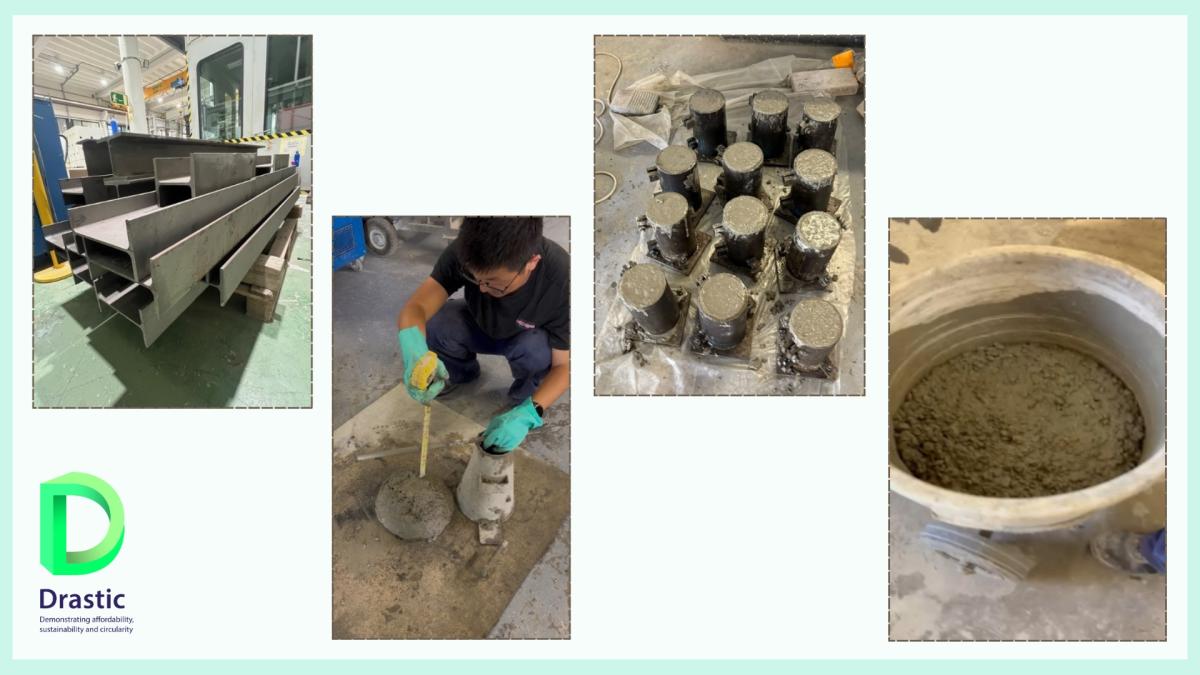
Testing processes by the Drastic Spanish Demonstrator
Drastic’s Spanish Demonstrator has been hard at work in recent months, using its first phase of development to test both steel and concrete products aimed at increasing circularity and reducing carbon emissions across the European built environment.
Forging a path for steel and cement reuse
Attending to the structural layer of buildings, the Spanish Demonstrator tackles two materials which can have the largest environmental impact within the built environment life cycle: cement and steel.
With no established ecosystem for the disassembly and reuse of structural steel elements, the Demonstrator looks to implement and prove the feasibility of such a system. As well as this, the project aims to repurpose white slag (a by-product from the secondary steel-making process) via its application as a supplementary material within concrete.
Low-carbon concrete
Researchers at project partner, Universitat Politècnica de Catalunya, have successfully developed a concrete mix design that maximises the content of white slag produced and supplied respectively by fellow partners CELSA and AdecGlobal. This innovative product is designed to be used for cement and fine aggregate substitution.
After positive mechanical and rheological tests, a full product characterisation will be carried out, after which further project partner, Sorigué, will use the concrete to build a foundation slab for the Spanish Demonstrator’s pilot structure.
Circular steel
Steel specimens reclaimed by project partner, Lezama Demoliciones, are already at the LATEM laboratory, ready to be tested by Escola de Camins (the Barcelona School of Civil Engineering) and Universitat Politècnica de Catalunya.
Currently, the steel’s geometrical features are being characterised and will be tested under several loading conditions so that its strength and suitability for reuse can be assessed.
In steel testing, geometrical features refer to the actual shape, dimensions, imperfections (such as bowing or warping), and tolerances (such as straightness, flatness, and perpendicularity) that define a steel component, significantly impacting its stability, load capacity, fatigue life, and overall performance.
The experimental testing programme will be complemented by advanced numerical and reliability studies, to ensure the Spanish Demonstrator is safe and efficient.
Stay tuned to learn more about the Spanish Demonstrator’s results!