


Drastic Newsletter December 2025
Drastic Newsletter December 2025 banner.
3 December 2025
Welcome to the winter 2025 edition of the Drastic project newsletter.
As the project nears its halfway point, this issue highlights the progress and collaborative achievements driving Drastic’s mission to accelerate circular, low-carbon and affordable transformation across the European built environment.
Recent months have seen project partners convening at the project’s General Assembly in Barcelona, contributing to international dialogues at events such as the Smart City Expo 2025 and Building Circular Futures, and advancing real-world innovations—from design for assembly and disassembly (DfAD) solutions to pioneering steel reuse and reclaimed timber traceability.
Drastic has also received prestigious external recognition, via project partner Produktif’s success at the 2025 Green Solutions Awards earlier this year.
Working with 23 partners across eight European countries, Drastic continues to show how its five Demonstrators, combined with improved circular business models, can pave the way towards a whole-life cycle decarbonisation of EU building stock by 2050.

Latest news
Partners gathered in Barcelona for Drastic’s General Assembly
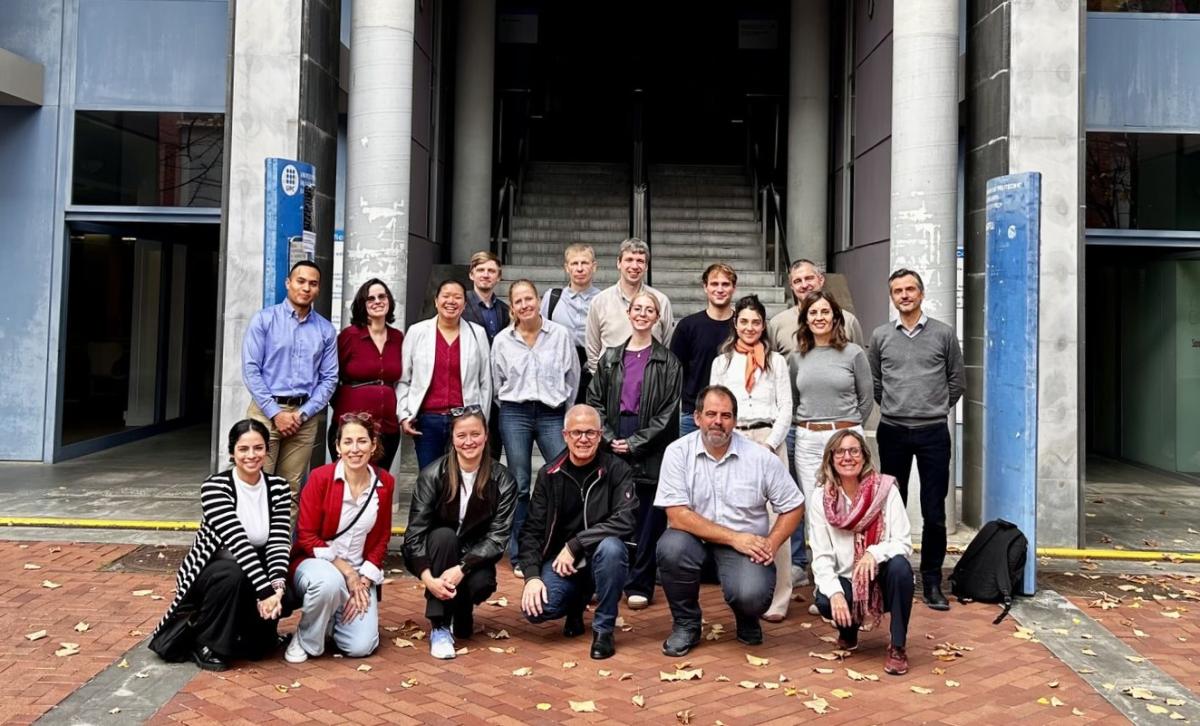
Partners in Barcelona, Spain, for the General Assembly.
Project partners convened in Barcelona, Spain, in November 2025 for the project’s bi-annual General Assembly, held at the Universitat Politècnica de Catalunya.
The two-day meeting held a special focus on the current challenges each Demonstrator is facing, and how these challenges can be overcome.
Agenda highlights included:
- Discussions on communication and dissemination activities.
- An inspiring presentation from social enterprise, Associació SaóPrat.
- An interactive session to uncover project insights and drive problem solving.
- A site visit to the Laboratory of Structural Technology (Laboratori de Tecnologia d’Estructures) at the Department of Construction Engineering, Universitat Politècnica de Catalunya.
- A product passport traceability exercise, reflecting on how data-driven tools can enhance value-chain transparency and sustainability.
Attendees also discussed how project innovations show that high-quality reuse is not only technically feasible and competitive with new products, but capable of maintaining near-original performance, even after decades of use. These results demonstrate that reused elements can be technically validated for both load-bearing and non-load-bearing applications—an important milestone for circular construction.
The General Assembly culminated with a special Drastic-hosted collaborative panel at the Smart City Expo 2025. The next General Assembly will be held in spring 2026.
Read more about the Drastic General Assembly here.
Drastic hosts Smart City Expo 2025 circularity panel
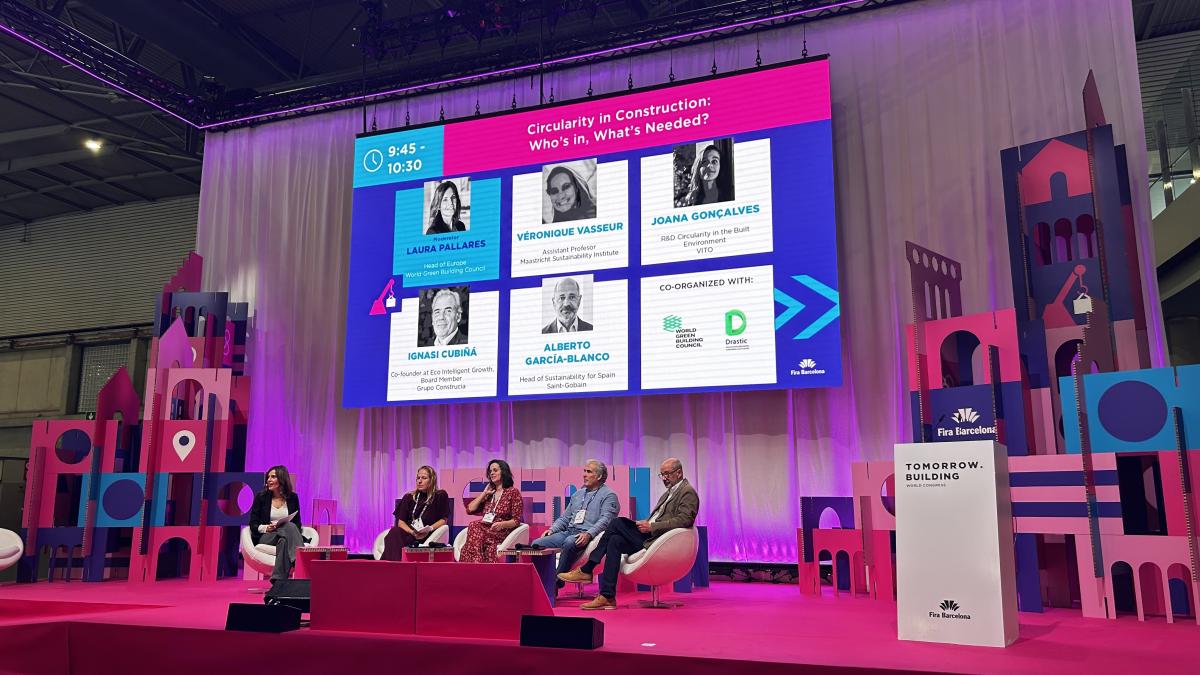
Members of the Drastic consortium conduct the Smart City Expo 2025 roundtable.
At this year’s Smart City Expo, held in Barcelona, Spain, members of the Drastic consortium hosted a special roundtable panel on Wednesday 5 November which offered the chance to explore one of the most pressing challenges—and opportunities—in the sector: how to make circular construction a reality.
The roundtable, entitled ‘Circularity in Construction: Who’s in, What’s Needed?’ was moderated by Laura Pallares (World Green Building Council), in collaboration with Alberto Garcia-Blanco Baeza (Saint-Gobain), Joana dos Santos Gonçalves (VITO), Véronique Vasseur (Maastricht Sustainability Institute), and Ignasi Cubiña (Grupo Construcía).
The discussion focused on what it takes to move from ambition to action across four dimensions: implementation, governance, finance, and mindset.
Looking ahead, the most transformative change envisioned was a financial sector and public administration that is fully aligned with circular principles, recognising circular construction as a smart and scalable investment for the future.
Read more about the roundtable here.
Advancing circular innovations via Drastic—Produktif celebrated at 2025 Green Solutions Awards
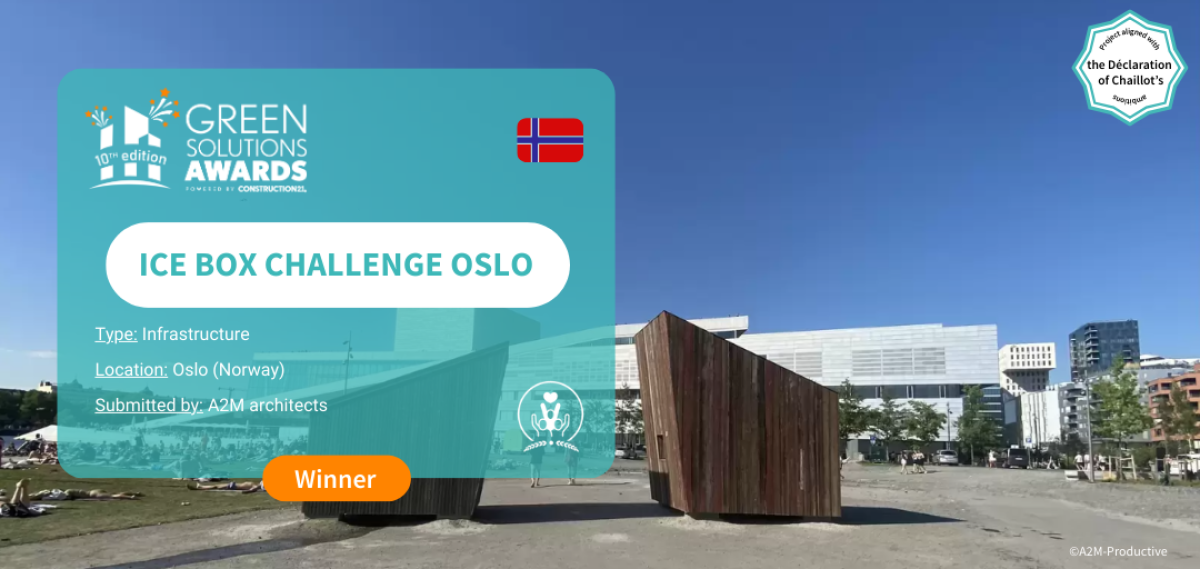
Green Solutions Awards Ice box Challenge winner.
Drastic partner, Produktif, earned major recognition at the Green Solutions Awards 2025 for their work on the 2024 Ice Box Challenge in Oslo, Norway, winning the National Award for Infrastructure and receiving a special mention for the Sustainable Infrastructure Grand Prize.
They also advanced to the international round, joining 60 finalists showcased at COP30 in Belém, Brazil, highlighting the international relevance of emerging Drastic innovations.
Produktif’s Ice Box Challenge entry demonstrated some of the key circular innovations shaping Drastic. Using their patented Design for Assembly and Disassembly (DfAD™) technology and C-Joint system—both featured in Drastic’s Norwegian Demonstrator—they built a highly efficient Passive House mini-home from reclaimed wood supplied by fellow partner, Omtre.
In a direct comparison with a standard-code house, the Passive House retained 150 kg of ice after 33 days of Norwegian summer heat, while the standard-code house’s ice melted completely after just 11 days. The result showcased the outstanding insulation performance and circular design potential of Drastic-aligned construction methods.
These achievements underscore how Produktif’s real-world testing and innovative design are advancing Drastic’s mission to accelerate European circularity.
Congratulations Produktif!
Learn more about the Green Solutions Awards 2025.
Learn more about Produktif’s work on the Ice Box Challenge 2024.

Meet the Demonstator
Drastic’s Spanish Demonstrator aims to establish a viable system for disassembling and reusing structural steel elements, for which no established ecosystem currently exists. It also seeks to repurpose white slag—a by-product of secondary steelmaking—as an alternative supplementary material in concrete to partially replace cement.
Led by the Celsa Group, with support from Lezama Demoliciones, Adec Global, the Polytechnic University of Catalonia (UPC), and Sorigué, this Demonstrator is located at Sorigué’s facilities in Balaguer, Spain.
Adec Global will tackle the pre-processing of the white slag, while UPC and the Celsa Group will conduct quality tests and determine the optimal substitution rate of white slag in place of clinker (the main component of cement), to ensure the material performs safely and effectively.
The project will culminate in the construction of a circular warehouse that incorporates reused structural elements from the dismantled Litoral Thermal Power Plant in Almería, Spain, deconstructed by Lezama Demoliciones.
By advancing steel reuse and the repurposing of white slag, the Spanish Demonstrator directly supports Drastic’s ambition to demonstrate how practical, industry-ready solutions can help scale circular practices across Europe.
Learn more about Drastic’s Spanish Demonstrator.

Recent project activities
Advancing Multi-cycle Sustainability in Drastic and beyond: new data protocol and design framework release

Construction site planning.
Drastic has recently published two deliverables that aid in its mission to increase circularity, sustainability and affordability across Europe: a Multi-cycle Sustainability Data Protocol and a Design Guidance and Assessment Framework.
These tools provide the foundations needed for consistent data collection, transparent assessment, and circular design across all five Demonstrator projects, with a view to their use and implementation extending far beyond the project itself.
Multi-cycle Sustainability Data Protocol – key features
- Establishes a unified data structure for Multi-cycle Life Cycle Assessments (MLCAs) and Multi-cycle Life Cycle Costing (MLCC) across all Demonstrators.
- Ensures consistent, comparable sustainability assessments via standardised formats.
- Supports building, element, and component-level evaluation aligned with European standards.
- Enables credible multi-cycle analyses, capturing environmental and economic impacts of reuse.
Design Guidance & Assessment Framework – key features
- Provides a decision tree supporting circular, sufficient, and multi-cycle design.
- Integrates indicators aligned with EN 15804:2012+A2:2019, Level(s), and EU Taxonomy.
- Supports data collection, traceability, and scenario planning across reuse cycles.
- Applied repeatedly across Demonstrators to validate carbon reduction and circularity gains.
Together, these tools strengthen Drastic’s evidence base and accelerate progress toward a circular, low-carbon European building stock.
View and download the data protocol & design framework here.
Estonia hosts workshop on design for assembly and disassembly
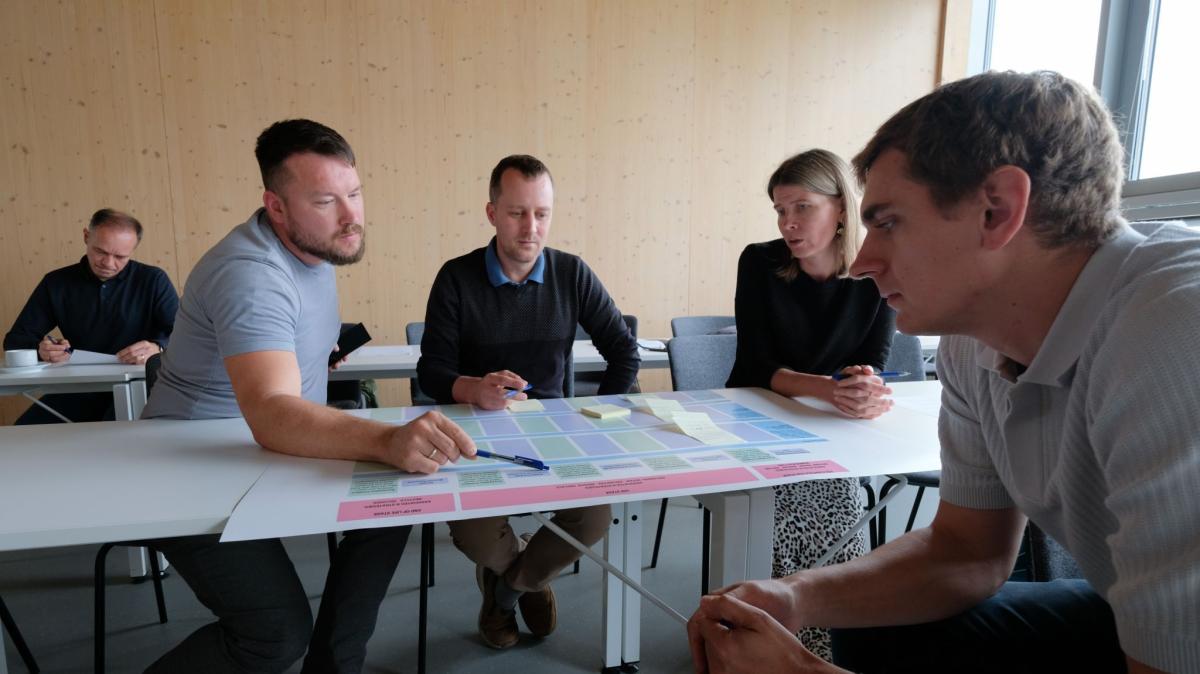
Attendees at the Estonian workshop.
Drastic’s Estonian Demonstrator leaders, TalTech (Tallinn University of Technology) and Timbeco, hosted a co-creation workshop in September 2025, in collaboration with Drastic’s fellow project partner, Maastricht Sustainability Institute.
The workshop spotlighted Drastic’s use of design for assembly and disassembly (DfAD), a design methodology that focuses on creating products that are easy to assemble during manufacturing and easy to take apart at the end of their life.
Workshop highlights included:
- Passionate and impactful discussions on how DfAD can be better integrated, scored and used within the construction sector.
- A discussion on European and Estonian circular economy policies, led by Mihkel Krusberg, Ministry of the Climate of Estonia.
- A presentation of circular renovation solutions and developments made in Drastic by Eero Nigumann, Timbeco.
- A discussion on the scoring principles of DfAD, led by Targo Kalamees, TalTech.
- A presentation of Nancy Bocken's new circular business model research by Hannah Lou Kings, Maastricht Sustainability Institute.
The workshop produced engaging and fruitful discussions between attendees and managed to capture the excitement and momentum of recent Drastic project developments and activities.
Learn more about Drastic’s Estonian Demonstrator.
Drastic at Building Circular Futures in Cape Town, South Africa

Attendees at the Building Circular Futures event in Cape Town, South Africa.
The Drastic project recently contributed to the hybrid event “Building Circular Futures”, organised by the United Village Global (UVG) – Association and Drastic project partner, Produktif.
Carolin Spirinckx, from Drastic’s coordinating partner, VITO, joined remotely to present the project’s work on linking ecosystems and business models. This approach is central to Drastic’s ambition to strengthen circular value chains in the built environment.
The event brought together a diverse group of practitioners, innovators, and community leaders, creating a constructive environment for exchanging ideas on advancing the circular transition. The discussions and experiences shared demonstrated how circular systems can thrive when knowledge is exchanged across sectors and regions.
For the Drastic team, the event highlighted the strong alignment between the project’s objectives and the many global initiatives pursuing similar ambitions. The project looks forward to continuing this shared journey toward circular and resilient futures.
From barn timber to biennial pavilion: pushing the boundaries of tagging and traceability in reclaimed materials

A member of the public scans QR codes from a pile of timber with their phone.
One of Drastic’s Norwegian partners, Omtre, recently had the opportunity to test its Demonstrator’s ‘smart tagging system’ at the Copenhagen Architecture Forum’s Copenhagen Architecture Biennial, via one of the event’s ‘slow pavilion’ structures.
The tagging system is a key element of Drastic’s Norwegian Demonstrator, which promotes the reuse of reclaimed timber from disassembled barns, and was used to help construct one of the event’s two slow pavilions, “Barn Again”, erected in the Copenhagen Cultural District of Denmark.
The pavilion was a contemporary re-imagination of the traditional Norwegian barn by Tom Svilans & THISS Studio, in collaboration with Bollinger+Grohmann and Winther A/S.
Using QR codes and labels, every unique timber element within the pavilion was linked to an online database carrying material information, timestamped images, and its exact position in the 3D model. This was crucial for managing sourcing, design, and production, since no two beams were alike.
This unique tagging system will be utilised by Omtre in their work on the Norwegian Drastic Demonstrator, which seeks to examine various uses of reclaimed timber (especially in temporary commercial structures) with a view to increasing circularity and reducing carbon emissions within the built environment via the use of reclaimed materials.
Explore the timber element database.
Read more about the slow pavilions.
Learn more about Drastic’s Norwegian Demonstrator.