


Drastic hosts Smart City Expo 2025 circularity roundtable
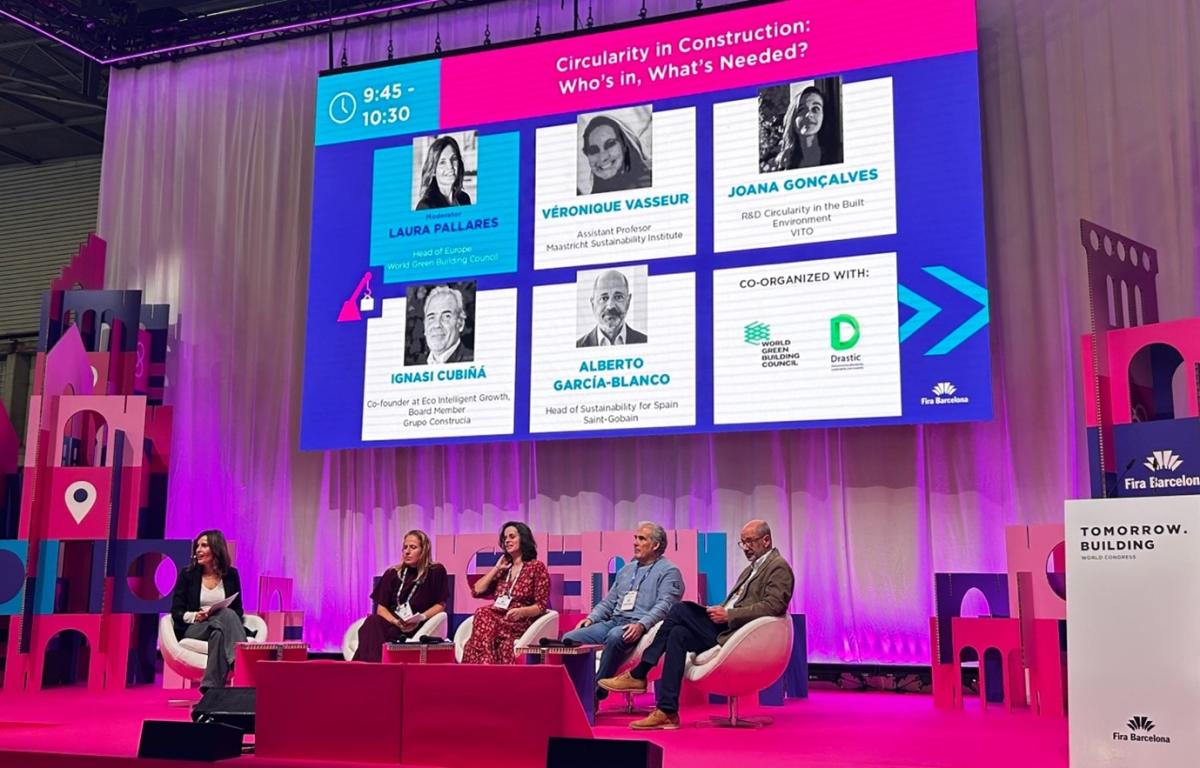
Members of the Drastic consortium conduct the Smart City Expo 2025 roundtable.
At this year’s Smart City Expo, held in Barcelona, Spain, members of the Drastic consortium hosted a special roundtable panel on Wednesday 5 November, which offered the chance to explore one of the most pressing challenges—and opportunities—in the sector: how to make circular construction a reality.
The roundtable, entitled ‘Circularity in Construction: Who’s in, What’s Needed?’ was moderated by Laura Pallares (World Green Building Council), in collaboration with Alberto Garcia-Blanco Baeza (Saint-Gobain), Joana dos Santos Gonçalves (VITO), Véronique Vasseur (Maastricht Sustainability Institute), and Ignasi Cubiña (Grupo Construcía).
The dynamic panel explored how governance and financial levers can accelerate the shift to a circular built environment. Drawing on insights from across the construction value chain, discussions focused on what it takes to move from ambition to action across four dimensions: implementation, governance, finance, and mindset.
Strategies such as waste prevention and secondary material markets, and EU policies such as Construction Products Regulation and Green Public Procurement were explored, along with how skills and capacity-building can offer a vital opportunity to drive systemic change.
Key insights from the roundtable included:
- Trust, collaboration, and common language are essential — from design to reuse.
- Circularity is not only a technical issue but also a behavioural one, requiring a shift in how materials, projects, and people are valued.
- Local jobs, inclusion, and social impact should be viewed as drivers of competitiveness rather than costs.
- Ecosystem thinking is needed — understanding circularity as part of a broader value chain rather than a single project.
- Governance and policy frameworks can accelerate change through incentives, simplified permitting, and valuing reuse.
- Finance is crucial: both public and private investors must understand the full environmental, social, and economic value of circular systems.
Looking ahead, the most transformative change envisioned was a financial sector and public administration that is fully aligned with circular principles, recognising circular construction as a smart and scalable investment for the future.