

Circular Ecosystem Business Model
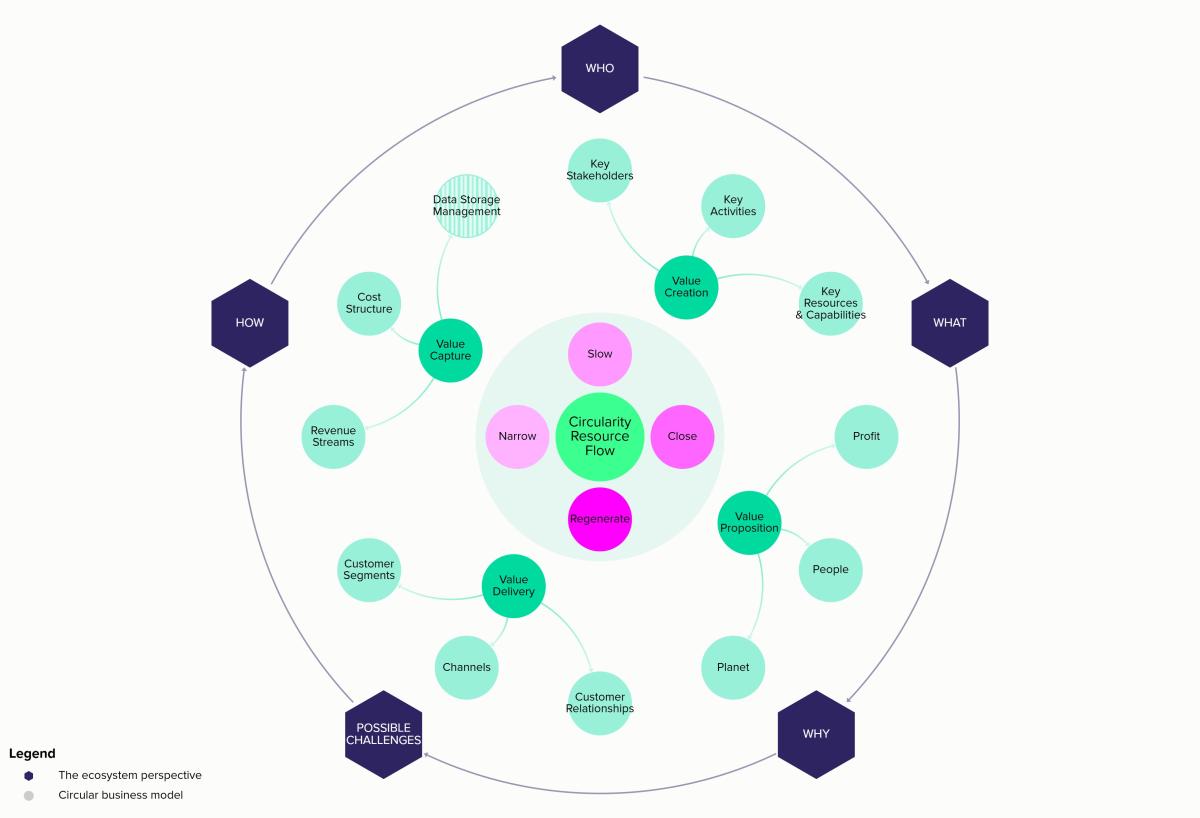
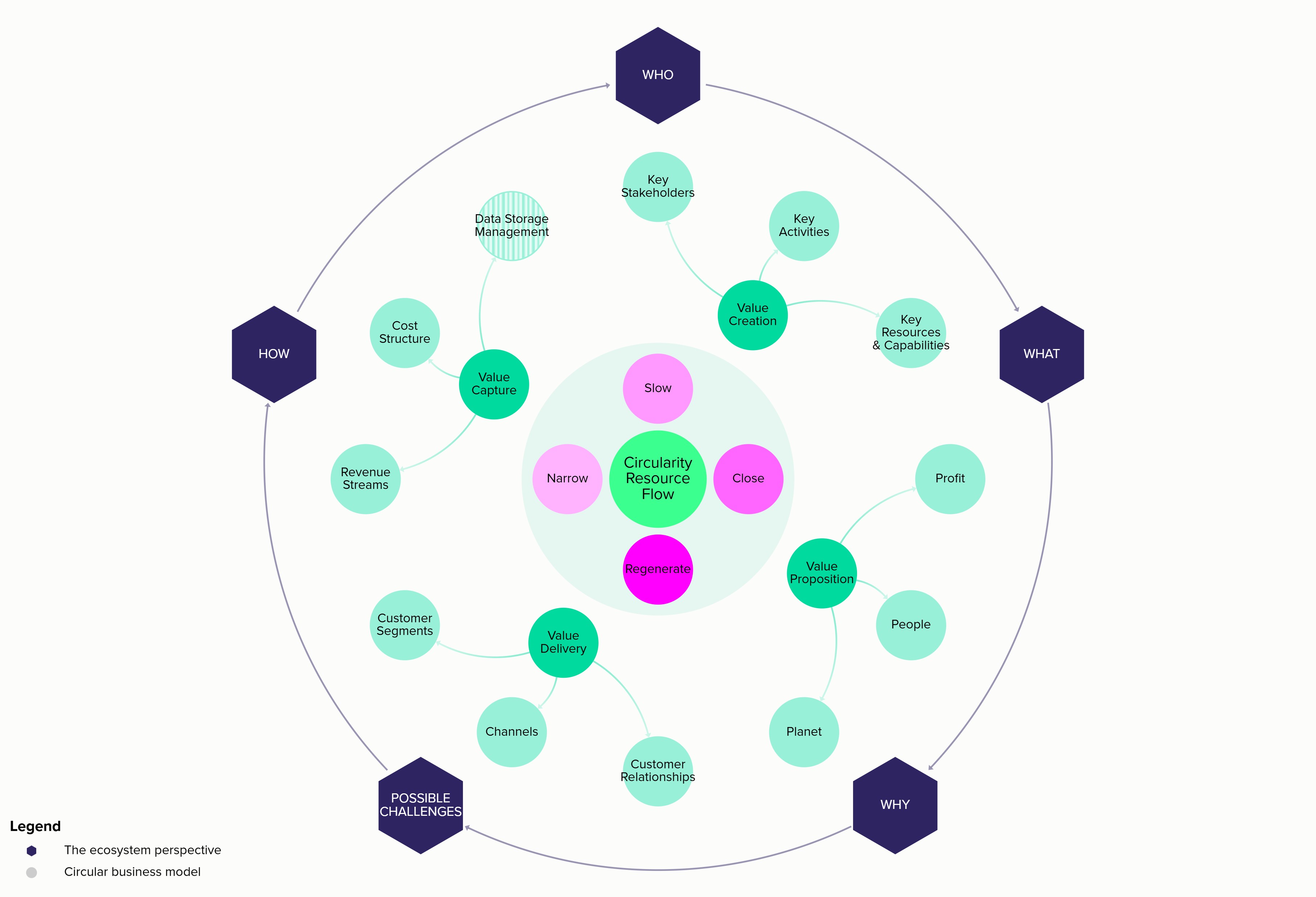
CBMs are designed to separate economic growth from resource consumption, waste and overproduction. They illustrate how firms create and deliver value, bring products or services to market, and generate revenue or capture other forms of value.
You can explore these aspects in the interactive map below by clicking on the blue and green circle elements.
Within the “Value Capture” element, the “Data Storage Management” striped element has been added. Data management has previously not been integrated into the value capture part of CBMs. However, our research suggest it is crucial to identify value in data in form of capturing data storage and management. When applying circular strategies and forming cross-sectoral collaboration in ecosystems beyond company boundaries, data turns into a crucial and determining form of value.
Sustainable business models promote circular strategies of slowing, narrowing, closing and regenerating loops (Bocken et al., 2021; 2023; Konietzko et al., 2020). You can find these loops explained in the interactive map, by clicking on the pink circle elements.
CBMs innovate diversely and on various ends of the value chain; some CBMs focus on waste management, other on additional sales through take back schemes. CBMs address multiple actors across economic, social, cultural, technological and institutional domains.
This is where the Ecosystem Perspective (EP) is crucial: for businesses to slow, close, narrow or regenerate resource loops, they need to collaborate closely with other organisations beyond their own boundaries to implement circular strategies across the entire value chain. The core aspects of the EP are shown in the dark blue hexagons within the interactive map.
Ecosystem thinking shows how interconnected and interdependent, yet independent, actors can work together to create value and drive the systemic change needed across entire value chains and beyond individual companies. In this approach, value is proposed, delivered and captured collectively.
By developing collaborative ways to design, use, produce and dispose of products and services, ecosystems support the circular economy’s aim of changing the flows of materials, energy and value. This value extends beyond financial returns to include knowledge sharing, the exchange of expertise and skills, and the reduction of negative environmental impacts.
How to use the Circular Ecosystem Business Model
The Circular Ecosystem Business Model has been designed on KUMU to widen organisations’ operational view beyond their products and business models to identify which external and cross-sectoral actors (Konietzko et al., 2021;2023) could be helpful in diffusing circular practices across the entire value chain.
Circular ecosystem partners operate at different stages of the value chain and depend on other actors, such as companies, end users and local governments. Successful circular initiatives therefore require strong coordination and communication between a diverse range of interdependent actors (Nussholz et al., 2023;2024).
The dark blue hexagons visualise the aspects that stimulate the reflection and inclusion of such actors. Click on the dark blue hexagons to explore what the EP entails and how it helps circular business models to form networks of businesses, governments and other actors that interact to gain market competition, innovate collaboratively and systemically replace linearity.
By applying the Circular Ecosystem Business Model, businesses create interconnected systems that work together to deliver circular outcomes, including products, services and shared value. Rather than operating as isolated companies focused on individual profits, they collaborate to create value in line with the principles of the circular economy. The KUMU map intends to visualise that various business models could be connected and added to the map within the ecosystem blue hexagons.
Explore the interactive elements of the the Circular Ecosystem Business Model here.