


Circular Ecosystems
An Introduction to Circularity in Economies
Research consistently calls for new ways to produce and capture value. For humanity at large, recent climate developments have become physically ever more palpable. There are no longer justifications for failing to change how society creates, consumes and disposes of things – including how the built environment is designed, built and managed. The construction sector is the waste and CO2 heaviest sector in Europe (Ellen McArthur Foundation, 2022). With its cross-sectoral complexity, it offers an ideal testing ground for changing practices of production and consumption.
Finding viable ways to meet the needs of today, whilst safeguarding the opportunity for future generations to meet their own, becomes ever more pressing and marks the term ‘sustainable development’ (Brundtland Report, 1987). Since practical ways to employ sustainability in all layers of society are required, the concept of circularity has emerged. It aims to make sustainability a reality in businesses and systemic in the economy.
To achieve sustainability in large sectors such as the construction industry, research calls for businesses to integrate circularity in business modelling through circular strategies. These strategies, such as slowing (reusing products), narrowing (using less materials per product), closing (reusing materials), and regenerating (using renewable and improving the environment) loops, need to be diffused along the entire value chain (Aarikka-Stenroos, et al., 2023; Bocken, et al., 2016; Fehrer, et al., 2023;2024).
From reducing material overuse at the design stage to improving waste and demolition management, circularity can only become viable through collaboration across the entire value chain, from pre-design to end-of-life. The Ecosystem Perspective (EP) offers an effective framework for fostering such collaboration (Aryee, et al., 2024; 2025; Konietzko, et al., 2021).
Why do we need Circular Ecosystems?
Ecosystems bring together diverse stakeholders from different sectors to create value collectively and share their expertise and resources. They help businesses collaborate and compete more effectively in markets that are still largely based on a linear economic model.
In such circular ecosystems, cross-sectoral actors collaborate for materials and competences, share resources and infrastructures, whilst co-creating and co-capturing circular outcome (Aryee, et al., 2024;2025; Diaz-Gonzales, et al., 2023; Geissdoerfer et al., 2025).
While conceptually established, empirical applications that integrate ecosystem thinking into circular business modelling (CBM) remain scarce. Research under the Drastic project has developed a business model that integrates the Ecosystem Perspective into circular business models, and can be found below as the Circular Ecosystem Business Model.
To enact this Circular Ecosystem Business Model (CEBM) in practice, a tool has been developed and tested using Desing Science Research, called the Circular Ecosystem Canvas, which helps businesses in their circular ecosystem formation through an applicable step-by-step exercise (Kings, et al., under review).
The tool, its’ conceptual background, and elaboration on how to use it, can be found here.
Circular Ecosystem Canvas
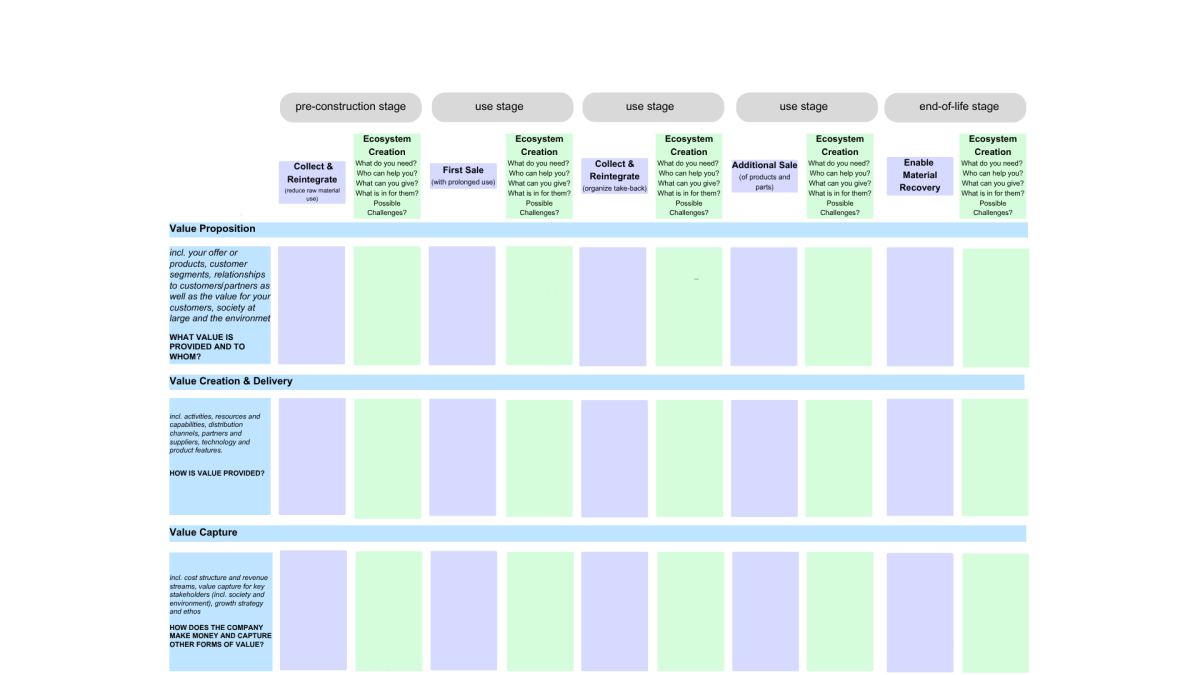
The Circular Ecosystem Canvas.
The Circular Ecosystem Canvas fuses the Ecosystem Perspective with circular business modelling (Kings, et al., under review). The Ecosystem Perspective encourages businesses to think in terms of networks, extending their focus beyond individual companies to a wider, cross-sectoral network of actors who work together to create value in the market. This reflects the principle that working together enables greater value creation than acting alone: “Better Together”.
For businesses to extend into such a network beyond their focal organisation, we have created the Circular Ecosystem Canvas (CEC): a step-by-step guide to begin thinking within ecosystems, so that circular strategies can be diffused throughout an organisation’s entire value chain network (Kings, et al., under review).
Designed to be used for both businesses and individuals, the CEC can help businesses refine their value propositions via ecosystem thinking and to design their business model into a collaborative network that co-creates value, whilst sharing resources and competencies.
Development of the Circular Ecosystem Canvas
Conceptually, the CEC draws on three theoretical concepts; the circular business model canvas (Bocken, et al., 2024), the ecosystem perspective (Konietzko et al., 2024) and the business model mapping tool (Nusshols, et al., 2018).
Blue Rows: First, the circular business model canvas identifies three major value aspects that constitute a circular business model: Value Proposition (what value is provided and to whom?), Value Creation and Delivery (how is value provided?), and Value Capture (how does the company capture monetary and other forms of value?).
Green Columns: Second, core characteristics of the Ecosystem Perspective identified in prior research were abstracted (Konietzko et al., 2021, 2024; Bocken & Coffay, 2023; Trevisan et al., 2022), leading to five key ecosystemisation questions: who (which actors) is/are required, what are they willing to invest, why collaboration is meaningful, what challenges may arise, and how collaboration can be governed.
Purple Columns: Lastly, to structure the canvas into feasible steps, inspiration has been taken from Nussholz's (2018) Business Model Mapping Tool, which marks four circularising interventions. In these steps the user is firstly invited to reflect on phases before the product is made, such as design and pre-construction phases: Collect & Reintegrate invites the user to reflect on how to integrate secondary production and materials.
Thereafter, the user is invited to reflect on sales: in First Sale prolonged use through reparation is explored, i.e. repair, whilst in Additional Sales, different ways to enable take-back schemes are considered, such as leasing, etc.
The last circularising intervention step invites the user to envision Material Recovery in which design for maximum recyclability after the product has been used is considered.
These steps have proven viable in practice for businesses to understand and apply rather theoretical conceptualisations of CBMs (Nussholz, 2018; Bocken et al., 2019; Pieroni et al., 2021).
The CEC offers users the opportunity to reflect on various aspects of a business model (blue rows), beyond the product and its material, whilst progressing ecosystem thinking (green columns) into deeper layers of circular business modelling (purple columns). It is intended to integrate ecosystem thinking into the strategies of a circular business model.
How to use the Circular Ecosystem Canvas
The canvas can be used by single or multiple persons. It is to be read left to right, along the value/product chain of design phase, first sales, additional sales and end of life (purple columns). Between each of those steps along the value/product chain, users reflect on the five key ecosystem questions, marked in the green columns.
Although this chronological order is not essential, it is the most logical approach. This logic is repeated within each of the three business model components (blue rows): Value Proposition, Value Creation & Delivery, and Value Capture. Users are advised to populate the canvas with sticky notes, so they can be moved along the canvas.
The Circular Ecosystem Business Model
CBMs are designed to separate economic growth from resource consumption, waste and overproduction. They illustrate how firms create and deliver value, bring products or services to market, and generate revenue or capture other forms of value.
You can explore these aspects in the interactive map below by clicking on the blue and green circle elements.
Within the “Value Capture” element, the “Data Storage Management” striped element has been added. Data management has previously not been integrated into the value capture part of CBMs. However, our research suggest it is crucial to identify value in data in form of capturing data storage and management. When applying circular strategies and forming cross-sectoral collaboration in ecosystems beyond company boundaries, data turns into a crucial and determining form of value.
Sustainable business models promote circular strategies of slowing, narrowing, closing and regenerating loops (Bocken et al., 2021; 2023; Konietzko et al., 2020). You can find these loops explained in the interactive map, by clicking on the pink circle elements.
CBMs innovate diversely and on various ends of the value chain; some CBMs focus on waste management, other on additional sales through take back schemes. CBMs address multiple actors across economic, social, cultural, technological and institutional domains.
This is where the Ecosystem Perspective (EP) is crucial: for businesses to slow, close, narrow or regenerate resource loops, they need to collaborate closely with other organisations beyond their own boundaries to implement circular strategies across the entire value chain. The core aspects of the EP are shown in the dark blue hexagons within the interactive map.
Ecosystem thinking shows how interconnected and interdependent, yet independent, actors can work together to create value and drive the systemic change needed across entire value chains and beyond individual companies. In this approach, value is proposed, delivered and captured collectively.
By developing collaborative ways to design, use, produce and dispose of products and services, ecosystems support the circular economy’s aim of changing the flows of materials, energy and value. This value extends beyond financial returns to include knowledge sharing, the exchange of expertise and skills, and the reduction of negative environmental impacts.
How to use the Circular Ecosystem Business Model
The Circular Ecosystem Business Model has been designed on KUMU to widen organisations’ operational view beyond their products and business models to identify which external and cross-sectoral actors (Konietzko et al., 2021;2023) could be helpful in diffusing circular practices across the entire value chain.
Circular ecosystem partners operate at different stages of the value chain network and depend on other actors, such as companies, end users and local governments. Successful circular initiatives therefore require strong coordination and communication between a diverse range of interdependent actors (Nussholz et al., 2023;2024).
The dark blue hexagons visualise the aspects that stimulate the reflection and inclusion of such actors. Click on the dark blue hexagons to explore what the EP entails and how it helps circular business models to form networks of businesses, governments and other actors that interact to gain market competition, innovate collaboratively and systemically replace linearity.
By applying the Circular Ecosystem Business Model, businesses create interconnected systems that work together to deliver circular outcomes, including products, services and shared value. Rather than operating as isolated companies focused on individual profits, they collaborate to create value in line with the principles of the circular economy. The KUMU map intends to visualise that various business models could be connected and added to the map within the ecosystem blue hexagons.